MINERVA project – mining on the terms of clean water, circular economy, and climate targets
MINERVA (MINeral Efficiency, Recovery and Valorisation in the Arctic) is a project in which we are developing a novel, circular economy-based mining and mineral processing model together with our project partners. The goal of the project is to demonstrate that mining can be built on the terms of the EU’s climate targets, clean water protection, and the circular economy.
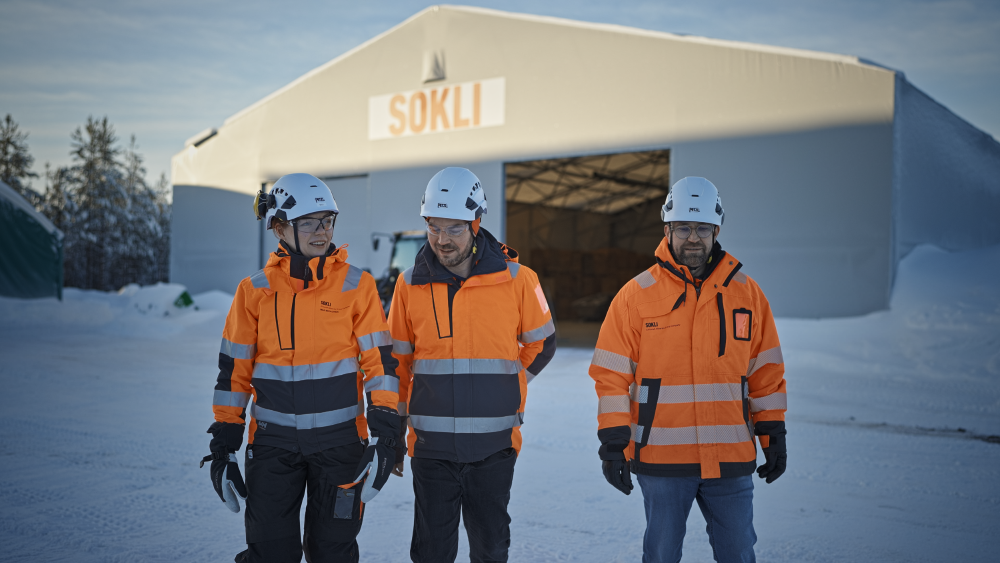
At the core of the project is the multi-product mine concept, which aims to maximize the utilization of raw materials from the excavated ore and reduce the environmental load of mining operations. The project is carried out in the Sokli mining area in Savukoski, Eastern Lapland.
The knowledge and operating models generated in the project can also be broadly utilized elsewhere in Europe. We aim to create a replicable model for responsible mining that secures the availability of critical raw materials and material efficiency, protects water bodies and the environment, and supports the EU’s clean transition.
The project is co-funded by the European Union’s LIFE Programme and supports the European Commission’s 2024–2029 target of securing Europe’s sustainable prosperity and competitiveness.
The project launched in July 2026, and its estimated duration is 3.5 years.
“The circular economy and the clean transition require that the standard of mining operations is raised. The piloting connected to the Sokli mining project takes place under continuous operation,
providing us with valuable information on the effects of seasonal variations already during the project. We can utilize the results in environmental permitting,
investment planning, and scaling up solutions.”
Pasi Heino, Acting CEO of Sokli Oy
The project develops better mining practices across several areas
The project consists of several distinct work areas aiming, among other things, to maximize the utilization of excavated raw materials, re-use generated extractive waste as circular economy cement and minimize the environmental impacts resulting from water and waste management.
1. A multi-product mine utilizes a larger portion of the excavated ore
The Sokli mineral deposit is globally unique. The deposit contains, for example, phosphate, rare earth elements (REE), and niobium. These minerals are critical for European food production, the clean energy transition, and low-carbon mobility.
The Sokli project aims to utilize as much of the excavated ore as possible. This multi-product mine concept is being developed as part of the MINERVA project. By maximizing the portion of ore utilized in downstream processing, the volume of waste generated is also reduced.
2. Water use and water management practices reduce environmental impacts
The project aims to significantly improve water reuse, reduce the mining operation’s need for clean fresh water, and substantially decrease the volume of water discharged into the environment as well as its concentrations of harmful substances. These objectives will be pursued through a near closed-loop process water cycle, chemical-free fine filtration, and reduced waste storage areas.
3. Cement from extractive waste
The MINERVA project is piloting a method developed by Betolar Plc in which extractive waste is refined into low-carbon circular economy cement. The method can reduce carbon dioxide emissions by up to 80–85 percent compared to traditional cement.
In the same process, metals remaining in the ore are recovered. This process further increases material efficiency and supports the decarbonization of construction.
4. Dry stacking reduces waste storage areas by up to 60 percent
In the project, wet waste storage is replaced with dry stacking and stabilized dry stacking. This reduces the surface area of waste storage sites by up to 60 percent and eliminates risks associated with dam failures and the leaching of harmful substances.
Furthermore, dry stacking allows extractive waste to be stored more safely, with the goal of also utilizing it as raw material for the construction industry in the future.
“Our key starting point is that environmental risks are identified and managed prior to actual mining operations, not during or after them.
The pilot enables the verification of water management, waste streams, and structural functionality on a smaller scale and under controlled conditions.”
Pasi Heino, Acting CEO of Sokli Oy
Project phases
MINERVA is divided into seven work packages that progress from planning to piloting and broader deployment of the results:
- Project management and coordination: Project leadership, quality assurance, risk management, and reporting.
- Pilot plant design: Design of the beneficiation process, tailings, and water treatment systems, as well as technical readiness for the pilot plant implementation.
- Pilot plant construction: Construction and commissioning of the systems required for piloting.
- Piloting and optimization: Testing solutions in real Arctic conditions.
- Impact assessment: Verifying the impacts of the solutions – including life-cycle analyses, cost analyses, and measuring environmental and societal impacts.
- Exploitation and scaling of results: Advancing pilot results toward industrial scale; aiming to create a replicable model for sustainable mining elsewhere in Europe as well.
- Communication and stakeholders: Stakeholder engagement and increasing the visibility of results to ensure their broad utilization.
Funding and partners
The total estimated cost of the MINERVA project is approximately EUR 8.8 million. Of this, the EU LIFE Programme finances approximately EUR 5.3 million.
Sokli’s share of the total budget is EUR 4.0 million, of which LIFE funding accounts for EUR 2.4 million.
Project partners:
Contact us
Business Development Lead Kasperi Karhapää
firstname.lastname@mineralsgroup.fi, tel. +358 40 3380415
Development Coordinator Jasmine Leiman
firstname.lastname@mineralsgroup.fi, tel. +358 40 6276365
Follow us on LinkedIn
Co-funded by the European Union. Views and opinions expressed are however those of the author(s) only and do not necessarily reflect those of the European Union or CINEA. Neither the European Union nor the granting authority can be held responsible for them.
MINERVA in our news